



From the top of this hill, you will see Bodrum.
And do not think you will leave as the same person who arrived.
Everyone who came before you has left a piece of their heart in Bodrum.
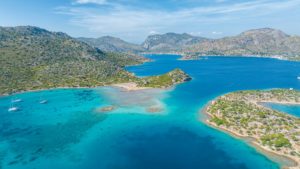
These words still welcome travelers along the road connecting Bodrum’s center to the airport, at the exact point where the view suddenly opens onto the Aegean Gulf, the Bay of Gökova, the Greek islands on the horizon and, just below, the historic heart of Bodrum dominated by its Castle. The sea is a deep blue, the houses are white, the sky crystal clear—an image that stays forever in memory.

Although Bodrum is today an elegant and cosmopolitan seaside destination, this panorama has captivated visitors for millennia. Among those who fell irrevocably under its spell was Cevat Şakir Kabaağaçlı, known as the Fisherman of Halicarnassus.

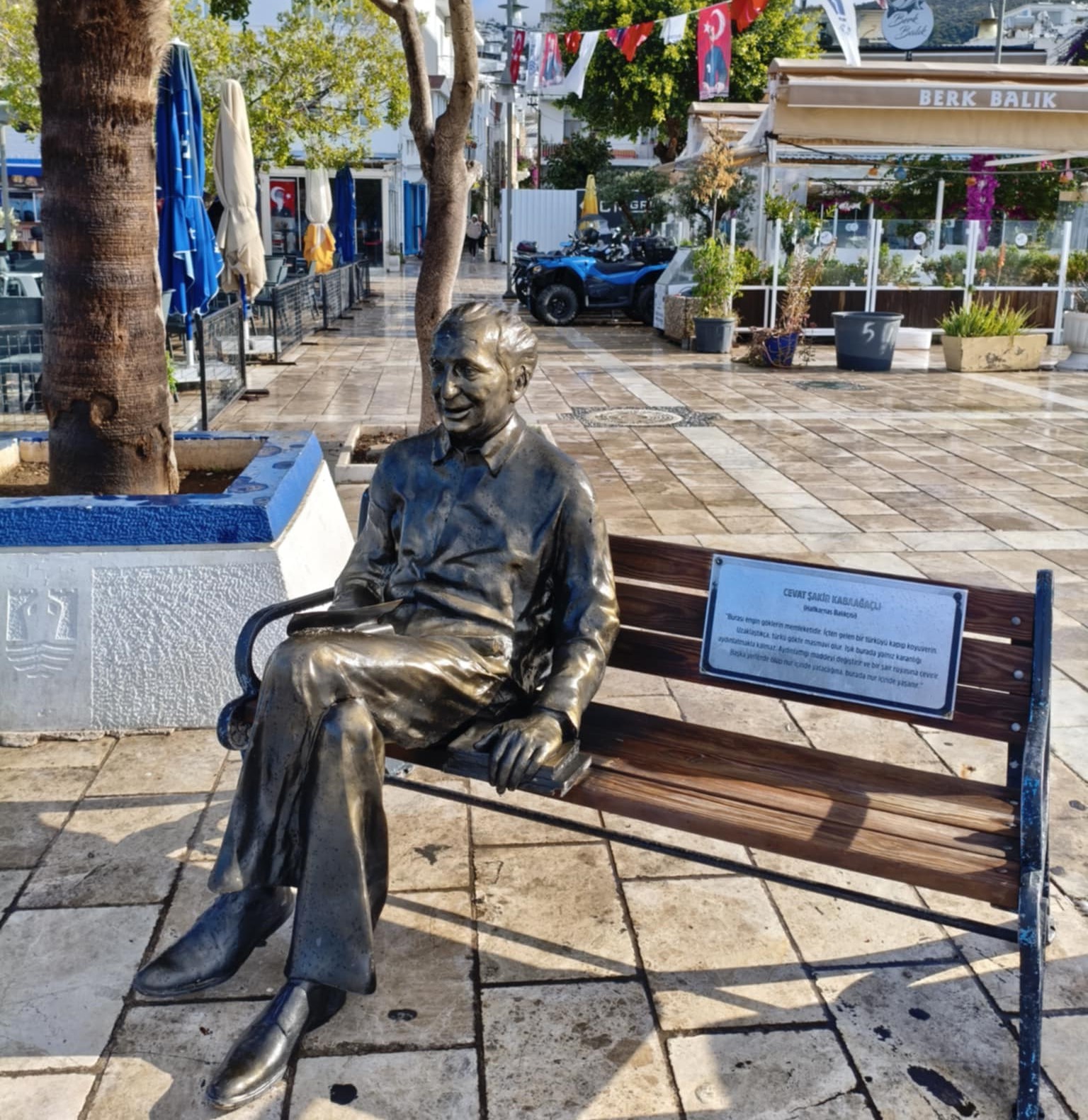
Today, at the top of that hill, it is his words that welcome visitors to Bodrum. His presence is alive everywhere: his statue on the Kumbahçe waterfront, seated on a bench facing the sea and the Castle; his bust at the entrance to the harbor; and above all his greeting, “Merhaba,” still spoken with pride by the people of Bodrum.
It is also thanks to him that Bodrum today possesses a nautical heritage unique in the world. The gulet cruise and the very first Blue Route were born right here.
The magic of the gulet cruise was not a carefully planned tourism project, but the result of spontaneous and almost accidental circumstances. The story takes us back to the early twentieth century, when this writer from Istanbul then Constantinople was found guilty of writing articles considered to incite military rebellion. The court initially contemplated a death sentence, but the final judgment became exile: Bodrum, then called Halicarnassus, a small and marginal town on the Aegean Sea.
Cevat spent half of his three-year exile in Bodrum. Precisely because the town was considered insignificant at the time, his confinement was mild: although formally a fortress prisoner at the Castle of the Knights of St. John, he was free to stroll along the harbor, befriend fishermen, and sail with them on small wooden boats to nearby bays.
That close contact with a community deeply bound to the sea, in a place steeped in history—from the Dorians to ancient Halicarnassus, from the Mausoleum, one of the Seven Wonders of the Ancient World, to the commercial routes of the Greek world, shaped his vision forever. After centuries of earthquakes, plunder, and decline, Bodrum came back to life through storytelling.
After completing the remainder of his sentence in Istanbul, returning to Bodrum felt natural. Here, Cevat lived for about 25 years, drawn by the love for its people, its nature, and a history he felt deeply his own.

Through his writings, he brought this fishermen’s town to the attention of Turkey’s intellectual elite and, later, to an international readership. His stories of a simple life, of boats, of the sea, and of an essential beauty sparked growing curiosity. Soon, the first travelers began arriving in Bodrum, asking fishermen to take them to the bays and islets they had read about in his books.
Those wooden boats without cabins or comfort, gave birth to the first Blue Cruises. An Aegean that Cevat described as “the bluest blue,” scented with Mediterranean scrub, a fragrance that—he wrote—even a blind man would recognize as home.

Between 1945 and 1946, he organized the first journeys known as Mavi Yolculuk, bringing aboard intellectuals and artists such as Bedri Rahmi Eyüboğlu, Sabahattin Eyüboğlu, Sabahattin Ali, and Erol Güney.
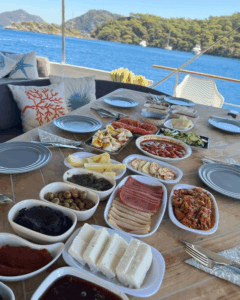
The essentials were few: a fishing gulet, a simple pantry with cheese, dried tomatoes, water, İstanköy rusks, tobacco, and rakı. No newspapers or radios—so as to step away from the world and reconnect with nature. After all, most of our planet is water, just like the human body; the sea is a natural element for humankind, a true remedy for well-being.
People slept outdoors or in tents, cooked in the bays, spent their days swimming, talking, and drinking rakı at sunset. Today we would call them hippie cruises. As their popularity grew, the first guesthouses appeared—farmers in the Bay of Gökova and along the Aegean coast opening their homes to travelers. Interestingly, official prices were set only in the 1960s; before then, guests simply left an offering.
These voyages—so different from today’s luxurious Blue Cruises—deeply influenced Cevat’s poems and stories about Bodrum, including the famous sentence displayed at the entrance to the city.
In 1973, Canadian traveler Hughette Eyüboğlu wrote:
“The most beautiful Blue Cruise of all time. We played cards, cooked local dishes, visited villages, and talked with the locals. The days were painted blue by the sea, the evenings orange by sunsets, and the nights filled with stars.”

During those journeys, the painter Bedri Rahmi left marks along the coast, including the famous fish mural painted on a rock in the bay that now bears his name, in Göcek, Fethiye.

In Cevat’s books, we find not only the story of a city, but a vision of the Mediterranean where the boundary between Greeks and Turks is not a barrier, but a cultural continuum reaching back to Homer, to the sponge divers of Kalymnos, and to the farmers of Kos. The sea has always united them.

When Cevat Şakir died in 1973, his final journey was a tribute to the life he had chosen. His coffin traveled along the street that now bears his name, Cevat Şakir Caddesi, and was placed on a gulet. The boat sailed past Kara Ada and the Bay of Salmakis, allowing the Fisherman of Halicarnassus to bid farewell to his Bodrum one last time.
He was buried on the hill above the city. On his tomb is carved the epitaph that captures the essence of his thought:
“The heavenly bliss of life in Bodrum is better than any eternal happiness that may await us.”

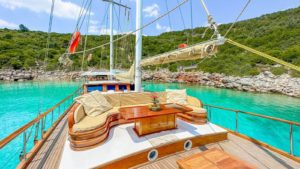
Sailing on a Budget: Unveiling the Charm of Economy Gulets